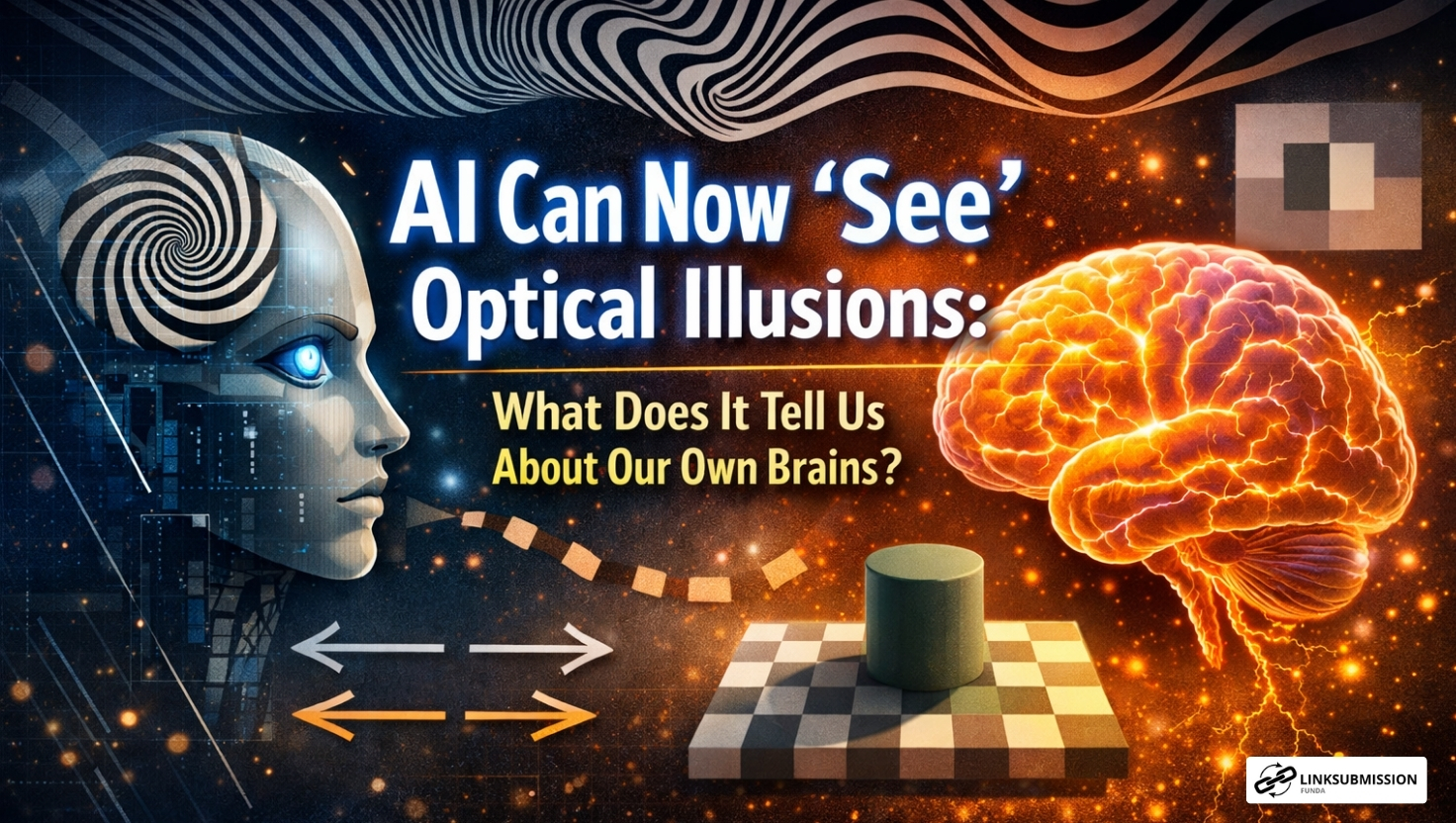
For decades, optical illusions have fascinated scientists, artists, and psychologists alike. These visual tricks—where what we see differs from physical reality—have long been considered windows into the human mind. Illusions such as the Müller-Lyer arrows, the rotating snake illusion, or the famous dress that appeared blue-and-black to some and white-and-gold to others reveal how our brains interpret, predict, and sometimes misinterpret the world. Now, something remarkable has happened: artificial intelligence systems can also “see” optical illusions. This development raises a profound question—what does this tell us about our own brains?
How Humans See Illusions
Human vision is not a simple camera recording reality. Instead, our brains constantly make predictions based on past experiences, context, and assumptions. Optical illusions exploit these shortcuts. For example, when two lines of equal length appear different due to surrounding shapes, the brain is applying rules it has learned about depth, perspective, and lighting in the real world.
In essence, vision is an act of interpretation. The brain fills in gaps, smooths inconsistencies, and prioritizes efficiency over accuracy. This is why illusions persist even when we intellectually know they are false—we cannot simply “turn off” our visual processing system.
AI and Optical Illusions: A Surprising Parallel
Traditionally, artificial intelligence systems—especially early computer vision models—were thought to operate purely on mathematical calculations. Unlike humans, they were assumed to lack perception, intuition, or bias. However, modern AI systems, particularly deep neural networks trained on massive image datasets, are showing something unexpected: they can misinterpret optical illusions in ways strikingly similar to humans.
When shown classic optical illusions, many AI vision models misjudge size, motion, brightness, or orientation, just as people do. For example, certain AI systems perceive illusory motion where none exists or miscalculate the length of identical lines when contextual cues are present. This suggests that AI, like humans, relies on learned patterns rather than direct access to objective reality.
Why AI Falls for Illusions
The reason AI can “see” illusions lies in how it learns. Modern vision models are trained on millions of images, learning statistical regularities in the visual world. They don’t understand images symbolically; instead, they recognize patterns, edges, contrasts, and textures—much like the human visual cortex.
When an optical illusion matches patterns commonly found in real-world images, AI systems apply the same learned rules, even if those rules lead to incorrect conclusions. In other words, illusions exploit the shortcuts AI has learned, just as they exploit ours.
This similarity challenges the idea that illusions are purely human psychological quirks. Instead, they may be a natural outcome of any system—biological or artificial—that must interpret complex visual data efficiently.
What This Reveals About the Human Brain
The fact that AI can experience optical illusions offers a new perspective on human perception. It suggests that our brains may not be as unique in their errors as once thought. Illusions may arise not from human irrationality, but from intelligent systems doing exactly what they are designed to do: make fast, probabilistic judgments in an uncertain world.
This also reinforces the idea that perception is predictive. Both humans and AI rely on prior knowledge to interpret sensory input. When predictions clash with reality, illusions emerge. Rather than being flaws, these misperceptions highlight the efficiency and adaptability of perceptual systems.
Using AI to Study Human Perception
Interestingly, AI is now becoming a tool to study the human brain. By comparing when humans and machines fall for the same illusion—and when they don’t—scientists can gain insights into which aspects of perception are shared and which are uniquely human.
For instance, if an illusion fools humans but not AI, it may point to higher-level cognitive processes such as attention, emotion, or cultural learning. Conversely, shared illusions may reflect fundamental principles of visual processing common to any learning-based system.
Broader Implications
The ability of AI to perceive illusions also has practical implications. In fields such as autonomous driving, medical imaging, and surveillance, understanding when AI vision systems might misinterpret visual information is critical. Optical illusions remind us that AI perception, like human perception, is not infallible.
More philosophically, this development blurs the line between human and machine intelligence. If both rely on learned assumptions and predictive models, then perception itself may be less about “seeing truth” and more about constructing useful interpretations of the world.
Conclusion
AI seeing optical illusions is not just a technological curiosity—it is a mirror held up to our own minds. It reveals that perception, whether biological or artificial, is shaped by experience, context, and prediction. Optical illusions no longer belong solely to psychology textbooks; they are now shared phenomena across human and machine intelligence.